All posts by Teri Maxwell

Teri Maxwell is wife to Steve for over 40 years, mom to eight children (three married), and grandma to eight. She loves keeping her home running smoothly and sharing with women in the vein of Titus 2:4&5. Teri homeschooled for thirty years, and she's graduated all her children. In between her other responsibilities, she manages to squeeze in writing time. She is co-author of the popular Managers of Their Homes and Managers of Their Chores. In addition, Teri's written three books just for ladies Homeschooling with a Meek & Quiet Spirit, Sweet Journey, and Sweet Relationships. She has been writing monthly encouragement articles for homeschool moms for 25 years. Find more information on Teri Maxwell and her books.

The Heart of Christmas

With Christmas on the horizon, our thoughts usually shift toward what that season means to us personally and to our children. Not growing up in Christian homes, Steve and I have had to develop our own traditions for celebrating the birth of Christ that would reflect the reality of Jesus Christ in our lives.

Knowing that December 25th was likely not the actual day that Jesus was born and realizing the pagan roots of a December 25th celebration, some Christians choose not to celebrate Christmas. If that is the case for you, this would not be a Mom’s Corner for you to continue reading. Our family chooses to celebrate Christmas because it focuses on the magnificent miracle of the birth of our Savior. Plus it is one of two holidays in which even the world expects Christians to participate. Here is a link to an article Steve wrote about why our family celebrates Christmas.

Santa Clause or Not?

After our salvation, one of the first things we eliminated that had to do with Christmas from our childhoods was Santa Claus. We didn’t want our children believing in Santa Claus only to find out later it was a lie. Some would say it is all in fun, but the reality is that it is deceitful. “Lie not one to another, seeing that ye have put off the old man with his deeds” (Colossians 3:9). We continued putting up Christmas stockings because of my heart attachment to each of the children’s Christmas stockings. Even though Santa Claus was no longer a part of this aspect of our Christmas, a couple of years later we simply wanted to be free of any association with Santa Claus in our Christmas celebration, so we even set aside the stockings.

Many years ago, we also realized that when one entered our home at Christmas time, the Christmas tree was the center of attention. However, we had a desire for the decorating in our house to reflect our worship of the Lord Jesus Christ and draw our hearts more closely to Him during this season.

So we began to cull out of our Christmas decorations any that were not Christ centered and to look for new ones to replace those we were no longer using. We also decided to stop getting a Christmas tree. While we wouldn’t say that Jeremiah 10:3-4 is talking about a Christmas tree directly, there are many similarities that are too powerful to ignore. In addition, I know I sometimes sat and admired the beautiful Christmas tree rather than worshiping my worthy Savior. “For the customs of the people are vain: for one cutteth a tree out of the forest, the work of the hands of the workman, with the axe. They deck it with silver and with gold; they fasten it with nails and with hammers, that it move not” (Jeremiah 10:3-4).

Christmas Shoe Box Outreach

As a family, we like to participate in a shoe box outreach where we purchase small toys and personal items to be placed inside a shoe box and given to a needy child in a third world country. We began doing this when a national ministry started a shoe box Christmas program. In more recent years, two missionaries to Mexico whom we support, have begun their own small-scale shoe box ministry. They collect the shoe boxes and then personally distribute them to children in their towns. That has made the shoe box shopping and giving even more special to our family because we have been able to see photos of our gifts being given to children.

It is a ministry our children have undertaken by financing it, doing the shopping, packing the shoe boxes, and getting them shipped to the missionary. The shoe box outreach affirms our goal of teaching our children the joy of giving. “I have shewed you all things, how that so labouring ye ought to support the weak, and to remember the words of the Lord Jesus, how he said, It is more blessed to give than to receive” (Acts 20:35).

About twenty years ago, I began saving the yearly Christmas letter and family photo that I was sending to others. Each year I would put the letter and photo into a scrapbook. This scrapbook has become a precious treasure summarizing the highlights of each year of our lives and documenting the changes that were occurring as the children grew. It is something I would have liked to have begun in my first year of marriage.

Christmas Caroling

Our family also has chosen Christmas caroling as a special way to share Christ at Christmas. We carol in our neighborhood as a family. The girls spend a great deal of time planning something to bake and give to those homes where we carol. Some years it has been a plate full of homemade cookies, while other times it was fresh baked cinnamon bread or poppy seed loaves. We also include a homemade card with a salvation Scripture. It is our heart’s desire that all of our neighbors would come to a saving knowledge of the Lord Jesus Christ. “For God so loved the world, that he gave his only begotten Son, that whosoever believeth in him should not perish, but have everlasting life” (John 3:16).

Our children love to give gifts to their family members. They group into teams of two or three and invest much time, thought, and prayer into their gift giving. They enjoy their shopping outings and gift-wrapping afternoons while keeping secrets, looking forward to pleasing the recipient of the gift. Through the years, we have monitored the children’s hearts, watching for greediness that focuses on what they get versus what they give. We have observed that the children’s greatest joy is in what they are giving to their siblings and other family members rather than what they will receive.

We have made a tradition of planning an evening near Christmas to take the family out to eat and then to drive around looking at Christmas lights. “Then spake Jesus again unto them, saying, I am the light of the world: he that followeth me shall not walk in darkness, but shall have the light of life” (John 8:12). While we drive, we listen to a powerful, dramatic presentation from Back to the Bible called the Twelve Voices of Christmas. We have done this for the past fifteen years, but we never tire of hearing the Christmas story through the hearts of the characters who were a part of it.

During Christmas week, Steve moves the reading during our family Bible time to the passages of Scripture from the Old Testament that are prophetic of Jesus’ birth and to the chapters in the New Testament that tell the story of God becoming a man. On Christmas night, we have a tradition that has been in place for a little over twenty years. My dad and mom started it for their grandchildren. It is now carried on to include the great grandchildren. My mom has a nativity that she sets aside for use only on Christmas night for our family Christmas program. The program includes reading Christmas-related Scriptures from both the Old and New Testaments plus singing Christmas carols that would relate to each passage of Scripture. My dad would narrate the program, and when he called out a Scripture reference, the person who had been given the slip of paper with those verses would read it. All of the pieces of the nativity set have been wrapped in tissue paper and numbered. At the appropriate place in the program, the little children get to come one by one to receive a part of the nativity set to be unwrapped and placed wherever in the nativity they want it to go. My mom keeps all of the supplies for the Christmas program—nativity, numbered tissues for wrapping the figures, Scripture reference slips of paper, carol word sheets, and the narrator’s paper together in her Christmas supplies. If you are interested in this homemade Christmas program, here is a link.

We have our family Christmas on Christmas Eve day. This began when our children were little, and we would spend Christmas Day with my parents who were our next-door-neighbors. Having our family’s gift giving on Christmas Eve freed up Christmas Day to spend at Grandad and Grandma’s. Now Grandad and Grandma’s health is such that all the celebrating is at our house so they are part of our Christmas Eve day. Opening our presents and having our Christmas meal on Christmas Eve now allows us time to go to the nursing home on Christmas Day. It gives our daughter-in-law, whose family lives close, freedom to spend Christmas with her family.

While the Christmas season can become hectic and focused on what has to be done, I want to encourage you to use that busyness to put your heart on worshiping your Lord and Savior, Jesus Christ. “Give unto the LORD the glory due unto his name; worship the LORD in the beauty of holiness” (Psalms 29:2). When I worship the Lord Jesus while I prepare for the celebration of His birth, my heart is set on things above. “If ye then be risen with Christ, seek those things which are above, where Christ sitteth on the right hand of God. Set your affection on things above, not on things on the earth” (Colossians 3:1-2).

May I suggest that you evaluate with your husband what is important for your family during the Christmas season and make sure that your time is invested in those priorities. Be sure Christmas is purposefully utilized to draw your children’s hearts to Jesus Christ and to serving Him.
From Lazy to Self-Disciplined – Part 5

As we continue our series of Mom’s Corners discussing moving from being lazy to being self-disciplined, I will first direct you to the previous four articles.

I have been asking others to share their strategies for how the Lord has helped them toward a self-disciplined life. Now I can give some of those to you so that you can be helped and encouraged by them too.

Jen sent me a whole list of her tips.

1. Everyone works together so that everyone can relax together. I try to be mindful that my husband is working at a job all day, and that I should be ‘on the clock’ too. Then, the children and I all do our morning chores at the same time. When no one is just sitting around, everyone works a little harder! It almost becomes like a race. The children scurry around trying to get everything picked up while I’m working in the kitchen because no one still wants to be in their area when the vacuum starts running. Work doesn’t have to be unpleasant, and a good old-fashioned competition spices things up!

2. Make a joyful noise!! This is a great time to see if you know all the verses to a favorite hymn by heart. Often, getting all the way through Amazing Grace is the same amount of time it takes to clean the bathroom—if I’m hustling. AND, I feel totally uplifted at the end.

3. Think of it as a gift. Despite my #1 point, there are definitely days off that I get that my husband doesn’t get (say days we don’t do school). I know that on those days I will get more time to put my feet up. So, it is a nice thing to clean the kitchen after dinner sometimes without asking for help and let him have some much-needed downtime too!

4. Pay attention to your best time of day to do ____________. I am most cheerful and energetic in the morning, so the best time for me to do chores is then. In the afternoon I’m better off grading children’s work, or prepping for the next day’s school. Because I know this about myself, different kinds of work feel less onerous. I frequently cook with my crock-pot, because I can make dinner in the morning then too!

5. Compliment yourself and your children on a job well done. Once a task is complete I love to sit back and say out loud, WOW! The ______________ looks sooooooooooooo nice! It directs everyone’s focus to the fact that our house is a more peaceful place when tidy.

As an aside, I think we all need to really pay attention to where we are in life too. As I finish out the first trimester of my fifth pregnancy in nine years, I know that my all day/night morning sickness has about a month left to go—maybe two. I honor the fact that the most important thing I am doing right now is growing a baby. If that makes me too tired to do everything I usually do, I ask for help, or in some cases I let things go undone. This is a time to talk to my children about the miracle happening inside me, to encourage them to help with the littles when I can’t and to come and read their school work to me when I am too sick to get up. It teaches them kindness, compassion, and understanding too!—Jen

As Jen suggested, by encouraging your children to work with you, you are helping them to develop self-discipline, a quality that will benefit them both now and in the future. Singing while you do what you need to do, if that is possible, raises your heart to praising the Lord in the midst of your work. Certainly when we choose to do something that allows our spouse to rest or frees them for another task, we have the satisfaction of loving and serving. Finally, Jen’s decision to pay attention to tasks that require more energy and then to schedule them when her energy level is higher helps her to be more willing to undertake the jobs that she might otherwise want to avoid.

In addition to the suggestions that Jen brought up, she turns our attention to another thing that we need to consider and that is what constitutes being lazy. She is at the end of her first trimester, and she doesn’t have the energy to do what she can do when she isn’t pregnant. Does that make her lazy? Certainly not. She is wise to listen to her body, rest when she needs to in order to care for her unborn baby, and let work go that she would normally do.

Along these same lines, I received this e-mail from Erin.

Thank you Teri for your Corners. I am struggling at the moment. In the Mom’s Corner you wrote, ‘If we don’t feel like working because we are tired, then it would be better to sleep and refresh ourselves than to fritter our time away doing nothing.’ How can we know if we really need to rest more, or if we should just keep pushing ourselves so that we are not being lazy? Sometimes I feel like everything is an effort, sometimes too much. I feel overwhelmed a lot of the time, but other days (not often enough) I have so much energy and achieve a lot. If I give in and rest, I will not get done all I need to to keep the house in order. Thanks again for all your encouragement. —Erin

I think this is a pertinent and serious question. For trying to determine whether you are being lazy or is just plain tired, I think you want to do two things: consider where you are physically and check your spirit. On the physical side, are you getting enough sleep? Do you have a nursing baby who gets you up in the night? If you know you aren’t getting enough sleep, then taking a nap in the afternoon isn’t being lazy. It is being prudent. You will get more accomplished with the other hours in the day, and you will have a more pleasant attitude as well.

If you are chronically tired for no apparent reason such as lack of sleep, then you want to check your diet and exercise. Are you eating a healthy diet? Sometimes we undermine our health by getting into habits of subsisting on caffeine pushes from coffee or soda only to have that cause health repercussions. Do you exercise? If you are not physically fit, you will not have a good energy level and will be more lethargic. It is possible that you need to go to a doctor to determine if there is a physical cause for being tired.

For the spirit check, ask yourself: Why is everything an effort? Is it because you don’t want to do it? Is it because you don’t like to do it? If that’s the case, then it could be laziness. This laziness manifests itself in thoughts like, “I don’t like what I have to do, and therefore, I resist it.”

As far as feeling overwhelmed, remember that last month, I encouraged moms to use a schedule. It makes you much more productive, and it helps you avoid that overwhelmed feeling.

I would also encourage you to ask your husband. Often those who know us best have a more realistic picture of us than we do ourselves. It might be that we are deceiving ourselves by saying that we aren’t lazy when in practice we are. It might also be, though, that we are pushing too hard when we need to slow down, and that slowing down isn’t lazy at all. It is being reasonable.

I still have suggestions that I want to pass on to you from several more moms on what helps them to be self-disciplined. I can continue with those next month. For now, I want to encourage you to have your heart set on what the Lord Jesus has called you to do. Be productive with your time, resting in Him to allow you to accomplish what He has set before you. If you are tired, evaluate whether there is a physical cause that needs to be corrected and take the necessary steps. Don’t call yourself lazy when you are not getting enough sleep because you were up in the night with children, and then you feel tired in the afternoon. Take a nap when the children do. Don’t feel like you need to push yourself when you are pregnant and have run out of energy at the end of the day, or even the middle of the day. However, if clothes need to be folded and you are surfing the Internet, then I encourage you to call it lazy. If it is time to start homeschooling and you are checking e-mail, then I suggest you determine that self-discipline is the better road for you. Get off the computer, and start school!

From Lazy to Self-Disciplined – Part 4

We have been investigating the challenging topic of how we can move from being lazy at heart to being self-disciplined. If you haven’t read the other parts in the series, you may do so.

In the previous articles, we looked at the biblical basis for choosing to be self-disciplined. Here is another verse to motivate us toward accomplishing what the Lord Jesus has set before us each day: “Slothfulness casteth into a deep sleep; and an idle soul shall suffer hunger” (Proverbs 19:15).

The time the Lord has given to each of us is a treasure, and He wants us to be good stewards of that treasure. This is evident in the parable told in Matthew 25:14-29. Are we using our time as the faithful servant who was given five talents and used it to get five more talents, or are we like the unfaithful servant who took and hid his one talent in the ground? When we are productive with our time, we are the faithful servant, but when we waste time, we are the unfaithful one.

On the practical side of self-discipline, I have found that using a schedule helps me not to be lazy. The schedule sets in front of me what needs to be accomplished, so I do not have to make dozens of decisions as I move through my day about what I am going to do next. Before using a schedule, with the ending of each activity, would come the temptation not to do what needed to be done. I had the option of deciding to do something I would rather do than what I needed to do, to do nothing, or to do a time waster—all of which were the lazy choices rather than the self-disciplined ones.

When I began making and using a schedule, I was seeking the Lord for what He wanted me to be doing and how to fit that into the available time. The right decision had been made when developing the schedule, and all I had to do was to follow it. In setting my schedule, I made sure to include personal activities that were important to me, such as Bible reading and prayer, exercise, and time with my children.  were not lazy or undisciplined activities. They were positive priorities for my time, and they were going to happen when they were in the schedule. For more detailed information on scheduling, I would recommend Managers of Their Homes.

Here is an e-mail that was generated from this Mom’s Corner series:

Mrs. Maxwell,

In reading your article “From Lazy to Self-Disciplined,” my question is would you further help me to define productive activities? I admit that I am not a very disciplined housekeeper. But many times I choose to spend time with my children (7, 4, and 1) and not on housework. The easy answer would be that the children and I would do the housework as our activity, but I know that the season of life we are in now is short. If my husband is okay with a little clutter, is playing in the sandbox with my little ones a productive activity? Should my focus be on raising my children or keeping the house?

Thank you,
Amber

I would encourage Amber that raising children and keeping house are not mutually exclusive. Playing with the children is a productive activity, but only when it is balanced with the necessary housework. If all a mom does is play with the children, then it would become a lazy choice, especially if she is avoiding her household responsibilities by doing it.

When using a schedule, there is time to keep house and play in the sandbox with the children. Both activities are important and productive. If Amber will schedule her children to work with her, she will not only be maximizing her time with the children but she will also be teaching them to be self-disciplined. Her struggle with being a disciplined housekeeper is most likely rooted in a childhood where she wasn’t encouraged to work; therefore, she didn’t learn the self-discipline that would be an asset to her as an adult. We had a series of articles on this topic not too long ago: Holly Homemaker.

Another way that I can direct you toward self-discipline is to make use of those little bits of time that are easily wasted whether one is using a schedule or not. Here is an example of that. In the morning, Steve and I walk for an hour, then I hang on an inversion table for my back, and next comes personal Bible reading and prayer time. Before I start my Bible reading, I prepare a moist heating pad by putting it in the microwave for three minutes.

Here is what I was able to accomplish in those three minutes when I tracked it one morning to share with you.

  • Got out vitamins.
  • Washed up several dishes sitting in the sink.
  • Took soiled towels to the washing machine.
  • Put items away that were out on the counter.


I could have spent those three minutes simply doing nothing or looking through a catalog. This is often the temptation when there are just a few minutes available. We tend to think it isn’t worth trying to be productive with that time. However, consider what one can accomplish in just three minutes!

Let me share with you the one testimony of ways to develop self-discipline that I received after my first request. This example fits in well with the suggestion to use small pieces of time productively.

“One practical way that I have found to combat laziness is to use a timer for my computer use. I set the timer for ten minutes. This gives me time to check my e-mail and maybe take a quick peek at a couple of other sites (like the Maxwell family blog!). I find that ten minutes a day is enough to do whatever I need to do on the Internet.

“I used to be always popping onto the computer to ‘check just one thing’—only to realize an hour had gone by. It was really just a lack of self-discipline and a lazy way of avoiding the tasks that I needed to be about. I was also searching for inspiration and affirmation on the Internet, instead of searching God’s Word.” Cherie

Cherie is utilizing a few short minutes and then choosing to be self-disciplined by limiting her computer time to what she has determined would be best for her. Setting the timer keeps her accountable to the standard that she has decided upon. Her method can work for any of us, and I think we can all relate to getting on the computer to see if we have any e-mail, thinking it will only take a minute or two, and suddenly realize an hour has gone by.

Since my initial request for suggestions on how to move from laziness to self-discipline, I have received several more, so I plan to share those in next month’s Mom’s Corner. For now, I encourage you to be a faithful steward of the time God has given you. Consider using a schedule to help you be productive and to minimize, or maybe even eliminate, the lazy time wasters in your life. I pray your heart will be pulled to the self-discipline that the Lord would want in your life.

From Lazy to Self-Disciplined – Part 3

Before we move to the Corner, I have to share with you about Sweet Journey, a book that we have just released. So many moms come to me, through e-mail and are struggling. As I have worked with them, giving them projects to help them to build foundations in their walk with the Lord, their e-mails suddenly take on a new lilt: one of excitement, encouragement, and hope! This book has been on my heart for many months, possibly even years, and it’s our prayer that the Lord will use it in the lives of Christian women throughout the world. For more information see this page.

This month we are continuing to delve into the area of moving from being lazy to self-disciplined. If you haven’t read the other two parts of this series here is the link.

In the first article where I shared an e-mail with questions on this subject that kicked off our discussion, one thing the mom asked me was if I thought other moms struggle with being lazy. I assured her that I expected we all do to some extent or other. I am now even more convinced of that because in the last article, I asked for readers to share their testimonies of moving from being lazy to self-disciplined. I only received one story!

We have evaluated the Biblical basis for choosing self-discipline rather than laziness in the previous articles. I encouraged you to be looking for verses that would endorse self-discipline rather than laziness as you were in the Word. Amy did just that. Here is what she wrote.

”I came across this verse while reading Ecclesiastes today, and I thought it fit with the current Mom’s Corner series. ‘By much slothfulness the building decayeth; and through idleness of the hands the house droppeth through.’ (Ecclesiastes 10:18)” Amy

This verse hits right where our hearts are—in our homes. A building decaying and a house dropping through could be literal or figurative. In the figurative sense, it might be along the lines of what we discussed last month. Our example to our children—whether it is an example of laziness of an example of self-discipline—will have profound effects in their lives. Laziness can be the root of children who grow up but cannot be successful in their adult lives. Certainly for a mother’s heart this would be a house that dropped through. Would it motivate us to be a model of self-discipline if we thought about the impact it might have on our children throughout their lives? Would we give in to laziness if we realized that it wasn’t just a harmless choice that we make with no visible consequences, but that it was a decision that could devastate our children’s lives?

Once we have it firmly embedded in our minds that laziness is to be avoided and self-discipline practiced, I would suggest we begin by taking it to the Lord. We can repent of our laziness and ask forgiveness by confessing them to the Lord Jesus. “If we confess our sins, he is faithful and just to forgive us our sins, and to cleanse us from all unrighteousness” (1 John 1:9). Then we will petition the Lord in our prayers for His grace and strength to help us change. He does tell us we can do all things through Him. “I can do all things through Christ which strengtheneth me” (Philippians 4:13).

The Lord Jesus also says that His grace is sufficient for us because His strength is made perfect in weakness. “And he said unto me, My grace is sufficient for thee: for my strength is made perfect in weakness. Most gladly therefore will I rather glory in my infirmities, that the power of Christ may rest upon me. Therefore I take pleasure in infirmities, in reproaches, in necessities, in persecutions, in distresses for Christ’s sake: for when I am weak, then am I strong” (2 Corinthians 12:9-10). Rather than feeling defeated because of our laziness, Paul would encourage us to see our infirmity of laziness as an opportunity for Christ’s power to become our strength.

Next I would encourage that we memorize—that in itself is a great self-discipline activity—at least one key verse that directs us to self-discipline and two or three would be even more helpful. Those verses are going to be the truth that we use to take our thoughts captive. “Casting down imaginations, and every high thing that exalteth itself against the knowledge of God, and bringing into captivity every thought to the obedience of Christ” (2 Corinthians 10:5).

Memorized verses will help us move our minds from “I deserve to do nothing,” or “I never have any time to myself” to the truth of “Serving is a blessing,” and “I want to do what the Lord has for me to do.” So when the self-indulgent thoughts begin to formulate, you can remember this verse, “. . . Arise therefore, and be doing, and the LORD be with thee” (1 Chronicles 22:16).

After the first article in this series, Amy also wrote this testimony about how she motivates herself to accomplish her tasks.

“I just read the Mom’s Corner about laziness versus self-discipline. I’ve realized that sometimes when I don’t feel like working it is because I am tired or overwhelmed with a task. But, I can also self-indulge and waste time too. I’ve noticed that I am happiest when my house is clean and organized. I am not happy when I spend time online and get behind on housework.

These realizations help me to make decisions. Should I unload and load the dishwasher or get on the computer? What is going to make me happiest in the long run? What is going to make my life easier? What is going to be best for my family? I’ve also realized that God has given me enough hours in the day to accomplish what I need to accomplish. I’m the one who wastes time and then gripes that I have too much to do.” Amy

Amy has some good insights into her heart and her time. How often it can be true that we murmur about being too busy, but then choose to waste time. If we don’t feel like working because we are tired, then it would be better to sleep and refresh ourselves than to fritter our time away doing nothing.

When a task is so overwhelming that we don’t want to attempt it, I have found that if I tell myself I am just going to work on it for a certain amount of time, I will get started. I often do that when writing a Mom’s Corner. Because I only have two homeschool students left and one doesn’t need any of my teaching time, I normally have two hours a day scheduled for computer time. During those two hours, I am mostly answering Titus2 ministry e-mails that Steve sends to me and other miscellaneous tasks that are done at the computer, but each month I also need to write a Mom’s Corner. That is more difficult for me than answering e-mail. So I will sometimes allow other computer activities, ones that aren’t as taxing as writing the Mom’s Corner, to be an excuse not to write it. Then I will determine that I will spend at least one hour on the Mom’s Corner each day until it is completed. When I am finished with that hour, I can move on to other computer tasks that aren’t as difficult for me. Before I know it, the Mom’s Corner is written, one hour a day at a time, and I am very happy to have it done! This tactic could apply just as well to fifteen minutes a day as to an hour a day. Rather than being overwhelmed, spend fifteen minutes on the task and be encouraged by the progress you will make.

I want to motivate you in your desire to please the Lord Jesus by letting go of laziness and developing self-discipline. The Lord’s grace is available to us in this task, and His power will allow us to be successful. As you make self-discipline one of your goals, you will find great personal blessings, and you will also bless your husband and children. Next month we continue with more practical ways to move from laziness to self-discipline. If you have any stories or hints you want to pass along, please share them with me. They will likely fit well into this series and be a help to others.

From Lazy to Self-Disciplined – Part 2

It would seem that most, if not all, of us have to battle that natural tendency to gravitate toward laziness. For some the tendency will be greater than for others, but it is a problem to some degree or another. Last month, I began the Mom’s Corner with a question from a mom recognizing that she was giving in to her laziness and asking for suggestions on how to build self-discipline into her life.

The beginning point for us as we move from laziness to self-discipline is to have a biblical perspective on both laziness and on self-discipline. Last month we started laying a biblical groundwork for why we would care about being self-disciplined. In one of the e-mail responses to the last Mom’s Corner, a lady shared a verse she likes that lends itself well to a biblical reason for diligence. Her verse is part of the description of the Proverbs 31 woman. “She looketh well to the ways of her household, and eateth not the bread of idleness” (Proverbs 31:27). She isn’t lazy but rather self-disciplined. We could go a little further with that Proverbs 31 woman if we read the whole chapter. She is a great example to us of what a woman who doesn’t eat the bread of idleness is doing with her time. Since the Proverbs 31 woman had servant girls, she would have had the luxury of letting others do the work in her household. She could have been lazy if she had wanted to do so. Obviously, her servants were working as well, but the Proverbs 31 woman still chose to get up early and work hard.

Here is another passage I think will encourage us to know that when we follow the Lord Jesus obediently, we set aside laziness: “For God is not unrighteous to forget your work and labour of love, which ye have shewed toward his name, in that ye have ministered to the saints, and do minister. And we desire that every one of you do shew the same diligence to the full assurance of hope unto the end: That ye be not slothful, but followers of them who through faith and patience inherit the promises” (Hebrews 6:10-12). Look at these words and phrases from this passage: “labor of love,” “ministered to the saints,” “do minister,” “show the same diligence,” “be not slothful.” What we do in serving in our homes is a labor of love, and it is ministering. We are encouraged to be diligent and not to be slothful. It is our faith in our Lord that enables us to do what He has called us to do, and we are to be patient as we fulfill that ministry; we are not to always feel anxious for it to be done so we can then do what we want to do, but we are to find joy in the work itself.

After last month’s Mom’s Corner, a very dear friend who writes every single month and comments on each Corner, shared this with me:

“I have a verse I have kept in my room for years … ‘Arise … and be doing…’ This helps me in those moments of weariness or indecision … don’t just sit there and vegetate…” Martha

I e-mailed her to ask permission to use part of her e-mail in the Mom’s Corner. When she wrote back, she gave me much more information about the verse and why it was motivating to her. I felt the verse and her thoughts on it fit well into our study, so I am including them here for you. This is the whole verse and where it is found: “Of the gold, the silver, and the brass, and the iron, there is no number. Arise therefore, and be doing, and the LORD be with thee” (1 Chronicles 22:16). Here is what Martha wrote:

“David spent the later part of his life laying aside the necessary building materials and resources that his son would need in continuing the work of the Lord in building the temple. David’s challenge to arise and be doing was the cry of a life that had been lived with purpose to please and honor God. It was for this reason that he could challenge his son to arise and be doing that work of the Lord. From 1 Chronicles 22:16, we get the feeling that there was no holding back in what David contributed toward his son building the temple.

“As we see in 2 Samuel 24:24, he would not give unto the Lord that which cost him nothing. ‘And the king said unto Araunah, Nay; but I will surely buy it of thee at a price: neither will I offer burnt offerings unto the LORD my God of that which doth cost me nothing. So David bought the threshingfloor and the oxen for fifty shekels of silver’ (2 Samuel 24:24). David himself worked tirelessly at this task that he would not finish but would pass on for his son to complete in his son’s lifetime. Would to God that we would all see the work that God has given us to accomplish for His Name’s sake (the raising of our children and supporting of our husbands) with the same sense of devotion and dedication that David did. There would be a difference in the continuing work of God in the lives of our children as they take our place for Christ in this world.” Martha

I liked and was challenged by the insights Martha pulled out of these Scriptures. If you would like to read the complete account of these situations, you can find them in 1 Chronicles 22:1-19 and 2 Samuel 24:1-25. A huge motivation for us as mothers is to evaluate the outcomes of our decisions in our children’s lives. David had been busy setting the example before his son Solomon of doing what the Lord wanted him to do. He invested of his time, resources, and energy. He was the epitome of ”arise and be doing for the Lord.” When David told Solomon to arise and be doing, Solomon had not only the direction but also the model from his father to help him accomplish the task. What about our lives? Do we ”arise and be doing”? Are we modeling for them a lazy lifestyle or a self-disciplined one? We are continually examples our children will follow. Are we positive role models, or are we negative ones?

Martha looks at that verse on her wall at times when we would say she has every right to vegetate—times of indecision or weariness. Her thoughts turn to the Lord and what He wants for her time and her life. When she gets up and begins doing, the indecision is erased. If she is weary, the Lord will renew her energy, or He will lighten her load. He wants her focus on Him, not on herself.

I know from personal experience that I end up being blessed when I get up and get busy rather than wasting my time. That time God has given me is a gift, and He has given me stewardship of it. I can be a good and faithful servant with my time, or I can fritter it away with nothing to show for it.

We are still laying the groundwork for moving from being lazy to self-disciplined. My prayer is that as you think about these verses and evaluate your life, you will be motivated to set laziness and time wasters aside, and that you will want to spend yourself in His service. Since we will be moving into the practical ways we can grow from laziness to self-discipline, I would love to hear your stories and be able to share them in this series.

From Lazy to Self-Disciplined – Part 1

Once again in this month’s Mom’s Corner, I would like to use some questions that came in via e-mail as a springboard. Here is what this mom is struggling with:

I was wondering if you had any advice (or possibly you could address this in a Mom’s Corner) on how someone can improve her work ethic. I am terribly embarrassed to admit this, but I really feel like at times I can be lazy. I know there are things that need to be done, but I just don’t feel like doing them! I realize that this is a sinful attitude, and I want to change. Do other moms struggle with this? Would you have any tips on how I can improve or Bible verses that could encourage me in this area? Self-discipline is a character quality I would very much like to see flourish in my life, and I would like to pass it on to my children!

One thing I can tell you is that you are most certainly not alone and that many, if not most, moms struggle with laziness to some degree or another. I expect it is part of the sin nature of flesh that we have all inherited from Adam. “For the flesh lusteth against the Spirit, and the Spirit against the flesh: and these are contrary the one to the other: so that ye cannot do the things that ye would” (Galatians 5:17).

Let’s begin by discerning if self-discipline is important and something for which we would want to strive. We don’t find the word self-disciplined in the Bible so we have to determine its value based on other criteria. Would the Lord have us to be self-disciplined, or would it be legalistic to feel like we need to be busy and productive with our time? We often hear the word legalism used against those who desire to follow the Lord Jesus in a spiritual walk of obedience. Let’s look at this verse. “For, brethren, ye have been called unto liberty; only use not liberty for an occasion to the flesh, but by love serve one another” (Galatians 5:13). Our liberty is freedom from the bondage of sin, and we are not to use it to serve ourselves but rather to serve others. If we are going to be servants in our homes, to those we love, and to those we come in contact with, it will take time and discipline.

“But the fruit of the Spirit is love, joy, peace, longsuffering, gentleness, goodness, faith, Meekness, temperance: against such there is no law” (Galatians 5:22-23). Here we have “temperance” as a fruit of the Spirit. Strong’s Concordance defines temperance as “self-control—the virtue of one who masters his desires and passions.” When we master our desires and passions, then we will be focusing our energy on the tasks the Lord Jesus has called us to do.

“And he said to them all, If any man will come after me, let him deny himself, and take up his cross daily, and follow me” (Luke 9:23). In order to set aside laziness, which involves self-indulgence, we have to deny ourselves. We will choose against what we might in our flesh choose to do with our time and rather decide to obediently accomplish what the Lord has set in front of us.

“. . . for my heart rejoiced in all my labour: and this was my portion of all my labour” (Ecclesiastes 2:10). The Lord wants us to have joy in the fruit of our hands rather than dread or avoid it. The work He sets before us is a blessing not a curse.

Scripture shows us that working, the opposite of being lazy, is positive. “Six days shalt thou labour, and do all thy work” (Exodus 20:9). For six days of the week, the Lord expects us to be diligently working, and on the seventh day, we get to worship and rest.

“The labour of the righteous tendeth to life: the fruit of the wicked to sin” (Proverbs 10:16). Our work, the fruit of self-discipline, leads to life. It allows us to complete what the Lord wants us to do, and it brings a sense of joy, peace, and contentment along with it. Sometimes we think that doing what we want to do leads to life but there is truth in this verse that it more often leads to sin.

Here is an interesting verse: “In all labour there is profit: but the talk of the lips tendeth only to penury” (Proverbs 14:23). Do you know what penury means? According to the Merriam Webster dictionary, it is extreme poverty. In our situation of desiring self-discipline to help us accomplish our tasks of mothering and homemaking, we aren’t talking about profit and poverty. However, we can easily discern from this verse that working is beneficial while “talk of the lips,” which could be equated with laziness, is harmful.

Our labor would be the choice to set ourselves to the tasks that allow us to love and care for our husbands, our children, and our homes. I think the “talk of the lips” would equate to time wasters such as sitting doing nothing, reading novels, Internet browsing and blog hopping, frivolous shopping, or large amounts of time on the phone. There is nothing wrong with these activities in and of themselves, but when we do them rather than the tasks the Lord Jesus has called us to do, then we have a problem and are entering into the realm of laziness rather than self-discipline.

“The soul of the sluggard desireth, and hath nothing: but the soul of the diligent shall be made fat” (Proverbs 13:4). I think sluggard would be a good word to apply to us when we allow laziness to creep into our lives and rule them. In this verse, we see that the sluggard wants the good things that come from working and self-discipline, just like we moms want the fruit that would come in our lives and home from these positive characteristics. However, it is not the sluggard who reaches that goal, but rather it is the diligent—the mom who is self-disciplined.

This section of Scripture provides us with a great analogy for self-discipline. “Go to the ant, thou sluggard; consider her ways, and be wise: Which having no guide, overseer, or ruler, Provideth her meat in the summer, and gathereth her food in the harvest. How long wilt thou sleep, O sluggard? when wilt thou arise out of thy sleep? Yet a little sleep, a little slumber, a little folding of the hands to sleep: So shall thy poverty come as one that travelleth, and thy want as an armed man” (Proverbs 6:6-11).

The ant works hard even though there is no one watching him, holding him accountable, or telling him what to do and when to do it. For the sluggard, the ant is set out as an example from which he should learn and one he should follow. If he will learn from the ant, he will become wise. In studying the phrase “a little folding of the hands to sleep” in the Hebrew that section doesn’t mean physical sleep but rather just resting. Resting could certainly be one root of our laziness, if it becomes the habit of our lives, because usually we are avoiding work that we need to do and are choosing to do something that we consider more restful, whether it is less physically taxing or less emotional taxing. Again, please don’t misunderstand me. It is okay to rest by doing things like sitting and talking to your family, rocking on the back deck while you look at the garden, closing your eyes for an afternoon nap if you are tired. However, when our lifestyle and focus becomes that of resting and avoiding what needs to be done, that is when we have a problem.

As we begin this series that is examining a move from laziness to self-discipline, the biblical view of those two characteristics is essential. We don’t have to look far to see that the Bible directs us away from laziness that indulges the flesh and toward self-discipline that denies the flesh. Perhaps as you are in the Word this month, you will discover more Scripture that reinforces self-discipline. Next month we will move into the practical aspects of developing self-discipline.

Summer Schedules and Chores

With the beginning of June upon us, a significant number of families will have different schedules and many hours to invest in activities other than school. The summer months afford us an excellent opportunity to re-evaluate children’s chore assignments and teach them new chore skills. It is also helpful to develop a schedule so we can accomplish all that is a priority for the summer.

When we assign our children chores, we don’t want to have to redo the chore plan until the following summer when we once again have the time to tackle it. During the summer my homeschooling hours are freed up for other projects and redoing the chore assignments will be at the top of the list.

We are particularly interested in evaluating whether older children are ready to learn some new chores while passing on a few of their well-practiced ones to younger siblings. It is also the chance to trade older-children jobs around so that each child learns every chore, becoming accomplished in it. Remember from the Holly Homemaker series having a clean home is only a part of why chores are important to us. We also want our children to learn skills that will facilitate their adult years. If a child knows how to clean the bathroom but not how to do the laundry, then we haven’t done our job as parents.

Scheduling Chore Time

Since revising the chore assignments is important to me, I put it into a summer schedule. “To every thing there is a season, and a time to every purpose under the heaven” (Ecclesiastes 3:1). We know that many who use schedules decide to eliminate the schedule for the summer, and that’s fine if that is the family’s choice. However, we have regularly heard from families who make that decision, but then are disappointed with their summer. Why are they disappointed?

They are disappointed because the activities that they planned to do and that were a priority for their summer weeks didn’t end up being accomplished. The children fussed and bickered with each other because of the lack of direction in their days. The time seemed to be filled with chaos, disorganization, and frustration. The family looks back over their summer days with dissatisfaction rather then the sense of fulfillment they were looking forward to in the beginning. After a summer with these results, they decide to return to a summer schedule the following year.

There are many things one can put into a summer schedule. It is helpful to begin the scheduling process by a family discussion and planning time. What are the priorities for family time and individual time?

If the family is homeschooling, summer allows us to do two or three hours of homeschooling a day while still leaving much of the day for other activities. With those two or three hours, the children’s day is more easily filled productively. Younger children will maintain the reading and math skills they are just beginning to learn. Older children can work ahead for the upcoming school year, which means there can be more flexibility in the normal school schedule. If a child had difficulty in an area or a subject, emphasis can be placed on that. Perhaps there are studies that simply haven’t fit into the school schedule because of higher school-time priorities. Summer will nicely accommodate those studies while still leaving plenty of hours for non-school related activities.

Organizing During the Summer

Maybe there is household organizing and cleaning to be taken on during the summer. Time can be placed into the schedule for that. Organizing fits well even into a half hour or an hour time slot. For many years when my children were younger, I did all my major cleaning and organizing tasks during a short little half hour each summer day. I gave one of the older children the responsibility of playing with his younger siblings for that half hour. I kept a running list through the rest of the year of projects and cleaning that were too time consuming for my normal daily schedule. Those were what I worked on during that half hour in the summer. I was always delightedly amazed at all I could get done when I applied myself for just one half hour a day. Not only can Mom get her de-junking accomplished, but the older children can as well.

In the schedule, we put in time for me to make us the new chore system and to implement it. After making the chore assignments, it will take my time to teach the older children their new jobs. If I have it as part of the daily schedule, I am most likely to actually get it done. The older children can teach the younger children the chores that they are handing down to them, but again, there needs to be time set aside in the schedule to do this.

It is also helpful to me to check the children’s daily chores until they become proficient at what they are doing. When I used to try to work the checking into an open spot in the day, I usually didn’t. However, when I started putting “check chores” as a short time block on my schedule, I became successful in the consistency that was important.

We want our children learning how to work, “Even a child is known by his doings, whether his work be pure, and whether it be right” (Proverbs 20:11). “It is good for a man that he bear the yoke in his youth” (Lamentations 3:27). Summer days give me the time to invest in their lives by working out the chore system, teaching the children how to do their chores, and then holding them accountable for what they did. Without the hours of homeschooling, my summer days maintain a more relaxed pace so that I have the freedom to spend in this beneficial pursuit.

Perhaps a summer schedule and a redefined chore system sounds like something you would want to see as a part of your summer but you don’t know where to start or how to go about it. We have two resources available to help you. Managers of Their Homes gives information and step-by-step-directions for setting up a daily schedule. If you would like to implement a successful chore system, we would suggest Managers of Their Chores as a tool to help you in that direction. We want to encourage you to ensure that you have something to show for your summer weeks and do not arrive at September with discouragement. Perhaps a summer schedule and a revised chore system will help you toward that goal.

Holly Homemaker – Part 5

The Holly Homemaker series has managed to draw itself out to encompass quite a few articles.

It started from a blog post on Titus2.com and a negative comment about that post. By now you are probably very familiar with the blog post and comment, but in case we have a new reader or you want to refresh you memory, here it is one more time.

5 Year Old’s Enthusiasm

chorepack

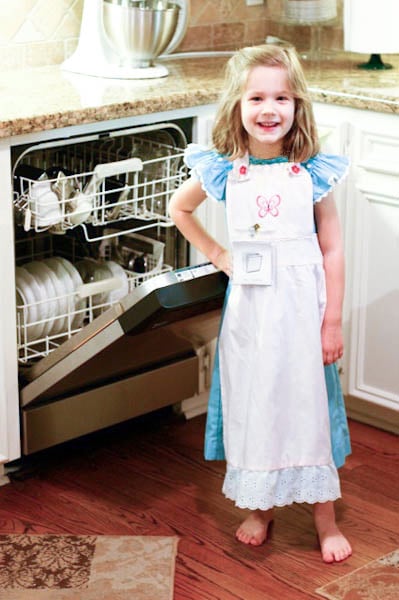
From a recent e-mail: “I wanted to send this sweet picture of our oldest, Audrey, wearing herChorePack the first week and getting ready to unload the dishwasher. She RAVED about how she loved the chore pack because it reminded her of everything she needed to do in the morning instead of her forgetting things that needed to get done. We’ve loved the system so far! Thank you for creating it.”

“Seest thou a man diligent in his business? he shall stand before kings; he shall not stand before mean men” (Proverbs 22:29).

Now, for the comment:

“That poor little girl. She’s happy because she’s pleasing mommy—like all children do. She should be out playing with friends, playing dress up or let’s pretend, MAYBE a few small chores here and there—but CHOREPACKS? You people are going to kill that child’s spirit before she’s 7. God forbid she wants to be anything other than Holly Homemaker—do they have ChorePacks for future lawyers? Or Astronauts? I hope that she grows up to realize that she’s worth more than just an unpaid scullery maid/nanny.”

From the blog comment, we are left with the feeling that the author believes that if a child is given more than a few small chores to do, he will not have any playtime. This is really far from the truth. After the first Holly Homemaker Mom’s Corner, the mom who had originally sent us the photo of her five-year-old daughter with her ChorePack unloading the dishwasher wrote to us. She was a little taken aback at the assumptions that were made in the blog comment concerning her daughter’s activities. This is what she said.

“I was so sad to hear about the woman who commented negatively and was thrilled to see your response. The sad thing is that the commenter does not even know the full story. We also use your scheduling system, and there is plenty of time scheduled for my daughter to play dress up, babies, play with her sister and brother, do school, and crafts, etc. I think this woman has no idea what your ChorePack system is about and the time actually involved in them. My daughter DOES want to be a mommy when she grows up and like you, I think it honors the Lord for her to do so.

“As far as how much time the chores take, my daughter is five so she is responsible for eight things in the morning: praying (she can’t read yet), getting dressed, putting PJ’s away, making her bed, brushing her hair, filling the cat’s water bowl, unloading the top rack of the dishwasher, and brushing her teeth. ALL of this takes her less than 20 minutes in the morning; sometimes she even gets her little sister dressed in that same amount of time.

“We also have an afternoon ChorePack where she waters our two houseplants, makes sure her room is picked up, puts books and toys away, sets the table, and is the kitchen helper if it is her day (she trades off with her brother). I would say this one takes her a maximum of thirty minutes because she usually helps me train our almost two-year-old in picking up her toys as well. So chores ALL DAY take less than an hour which leaves eleven hours for fun and school since the children are up from 7 a.m. to 7 p.m.

“I didn’t even know how to turn on the washing machine when I went to COLLEGE. I had to have my mom come up and show me how to run it when she was visiting the first week. How sad! You would think my mom would be anti-chores since she did everything for us, but she loves the idea that we are training our children on how to keep up with themselves and be responsible, God-fearing adults.” The five-year-old’s mom

The precious, little ChorePack-using girl’s mom gives us a good perspective of what her daughter’s day looks like and how much of it she is spending doing chore work. The jobs are reasonable to her age and capability. Her mommy is helping her invest her time in productive activities like chores and school while allowing plenty of time for play.

To be honest with you, I wonder if the children who will grow up to be lawyers and astronauts aren’t quite possibly the ones who are learning to work at home rather than the ones who are addicted to TV, movies, and Xboxes.

I remember a conversation we had with one of our neighbors who drives a public school bus. She told us that she asked the children on her bus how many of them played outside. Only two raised their hands. She decided to give them a “play-outside challenge.” We had recently had a seven-inch snow, and there was still a lot of snow on the ground. She told her bus children that when she came to pick them up in the morning, she would give a reward to any child who had built a snowman by the bus stop. There was only one child who responded to the challenge of building a snowman that was visible on the route the next day. That child was treated to a McDonald’s Happy Meal.

When children are given chores to do, they are learning to apply themselves to a task that needs to be accomplished. They have something productive to do with a portion of their time. With practice at their chores, they become responsible, diligent, thorough, careful, and efficient. They also learn how to manage their time. All of those are qualities that a professional will need just as much as the Holly Homemaker needs them. The children who learn how to work at home will have the perseverance and determination to apply themselves to difficult tasks they will face in adulthood–whether that is starting a business, becoming an astronaut or lawyer, or raising a family.

Sadly, the children who grow up without being encouraged to work will likely choose to avoid work in their adult lives. They will perpetuate their childhood into their adult years and wonder why they struggle so much. Remember from the March 2011 Holly Homemaker Mom’s Corner where the professional couldn’t find young employees because none of those who applied for the jobs knew how to work?

Those who haven’t learned how to work will not be qualified to be the leaders of their generation because they have set their hearts and affections on fun and games rather than industry and service. Chores and working don’t kill a child’s spirit, instead they develop, enhance, challenge, and produce the kind of spirit that will make that child successful as an adult. It is the children who are left to sit in front of the TV with their XBoxes whose spirits are being killed. Those spirits are being sucked into the mire of self, mindlessness, and entertainment. Could it be that these children are developing the appetites that will make them be “lovers of pleasures more than lovers of God (2 Timothy 3:4)?”

Here is one more comment that I wanted to include in this series:

“When we learn to work together and when the children work before they go play, we are all happier plus Mom might be freed up enough to play with them.” Mom O

I agree with Mom O that as the children pitch in to help in their homes, Mom’s workload is lightened. This allows her not only her more time to play with her children, talk to them, and read to them, but it also helps facilitate a more joyful, content overall attitude. A happy mom is often the foundation of a happy family.

In the past, Steve and I listened to those, like the negative blog commenter, who would want us to choose not to give our children chores but rather simply let them play and have fun. We also evaluated the results of that kind of parenting, and we didn’t like the results. We saw appetites developed for self and entertainment but we desired our children to have appetites to serve. Working helped our children toward the servant’s heart found in Scripture. “For, brethren, ye have been called unto liberty; only use not liberty for an occasion to the flesh, but by love serve one another” (Galatians 5:13).

Others, as they have shared through this series of articles, have seen the bad results of children not learning how to work, as well. This was usually from personal experience in the area of not having been given chores as they were growing up.

When we did a survey of Christian families before writing Managers of Their Chores, overwhelmingly we heard back that these families wanted to teach their children how to work. About 75% of the respondents came from families where they were not required to do household chores, and they felt that decision by their parents had hindered them as adults. They didn’t have the skills they needed or the attitudes toward work that they wanted. They simply weren’t equipped for what they would face as adults. These families are making different decisions for their children, decisions that include a positive attitude toward chores and teaching their children to handle chore responsibility.

I think in this series we have now covered each of the concerns the negative blog commenter had about a five-year-old having a ChorePack to help her do some household chores. I am happy that I can be a Holly Homemaker and that one of the things I can do being home with my children is to teach them how to work. We want our children equipped for their adulthood through the skills they are learning when they work in our home plus the work ethic that comes with chores as well. May we be women who look beyond the cries of the world that says a child’s days should only consist of fun and choose to prepare our children for life.

Holly Homemaker – Part 4

This month we delve once again into a comment that was left on our blog in response to a blog post. We didn’t approve the comment on the blog, but we saved it so that we could address the concerns that it was raising. If you’d like to read the previous articles in this series, please do so. Here is the blog post and the comment that is the basis for this series of articles.

5 Year Old’s Enthusiasm

chorepack

From a recent e-mail: “I wanted to send this sweet picture of our oldest, Audrey, wearing her ChorePack the first week and getting ready to unload the dishwasher. She RAVED about how she loved the chore pack because it reminded her of everything she needed to do in the morning instead of her forgetting things that needed to get done. We’ve loved the system so far! Thank you for creating it.”

“Seest thou a man diligent in his business? he shall stand before kings; he shall not stand before mean men” (Proverbs 22:29).

Now, for the comment:

“That poor little girl. She’s happy because she’s pleasing mommy—like all children do. She should be out playing with friends, playing dress up or let’s pretend, MAYBE a few small chores here and there—but CHOREPACKS? You people are going to kill that child’s spirit before she’s 7. God forbid she wants to be anything other than Holly Homemaker—do they have ChorePacks for future lawyers? Or Astronauts? I hope that she grows up to realize that she’s worth more than just an unpaid scullery maid/nanny.”

I have addressed the benefits that I have found in my life of being a Holly Homemaker and how we would like our daughters to choose to be Holly Homemakers when they are married. Last month we started evaluating the part of the comment where the author indicates that she/he doesn’t think a child should have more than a “few small chores here and there.” Obviously a five-year-old unloading a dishwasher is beyond the chore criteria that the blog commenter would feel is reasonable. In the previous article, we observed that in real adult life everyone will have daily, household responsibilities. Learning to do chores as children simply prepares our children to handle those tasks as adults and to have positive attitudes toward them.

One mom wrote to me and listed the chores her children are doing and why it is critical to her that her children learn to work. Here is what she said.

“Today, my four-year-old washed the breakfast dishes and loved it. My six-year-old also does dishes, some sweeping, and setting/clearing the table. Between them my ten and nine-year-old sons sweep the kitchen, keep the house vacuumed (except for the master bedroom and basement), do the garbage and recycling duties, clean the garage, do other yard work as asked, clean the bathroom sinks and toilets daily, take care of the dinner dishes most nights, and sometimes cook a simple meal here and there.

“Recently a neighbor asked if the two older ones would be interested in helping her clean the stables of her little horse farm. She’s getting older and is unmarried. They were very enthusiastic even when they had no expectation of reward. I doubt that if it weren’t for the chores they have to do at home that they would be very eager to perform what they know will be reasonably demanding labor. “Our ‘chore life’ is not perfect, but it’s a long way from what I grew up with. I can remember moaning and fretting about small tasks until my mom gave up, and in the end, I don’t think I had any household responsibilities by the time I finished high school!!

“Anyway—all this to say: CHORES ROCK!” Mom I

When I e-mailed to ask permission to use Mom I’s testimony about chores from her childhood and chores for her children, she sent me a bit more of the story. This is what she said.

“After I emailed, I was thinking also about how my mom said when I was in my early teens that I should make a meal once a week. I just sort of ignored that, and nothing happened. Some time later my mom suggested maybe I should make a meal once a month. I didn’t pursue that either and eventually the whole matter was dropped. At the time I was thrilled. So of course when I eventually needed to make meals, I was quite lost, and still had the sense that this was ‘not my job.’ Perhaps that’s some good coming out of the fact that my mom didn’t persevere in having me do chores—it made me realize that it’s important to me that my children learn how to work! :)” Mom I

From Mom I, we have the perspective of growing up in a home where the children were given no chore responsibility. However, coming to her adult years and motherhood role, Mom I was not prepared. From this experience, she is choosing to raise her children in a different manner by teaching them how to work at home. From that decision, she is already experiencing children who can contribute a substantial amount of help to the household chores, and they are also being sought after for their diligence and skills by others even though the children are only nine and ten. In addition, these nine and ten-year-olds are excited about working to help the neighbor even though they aren’t expecting to be paid. “For, brethren, ye have been called unto liberty; only use not liberty for an occasion to the flesh, but by love serve one another” (Galatians 5:13). Don’t you think that those are children who have the potential to be whatever the Lord Jesus calls them to be in their adult lives?

This is another testimonial that was sent to me after the first Holly Homemaker article where the mom was raised in a home without being taught how to work. She shares the results of that kind of childhood and what she thinks about a five-year-old who is learning to do chores. “Go to the ant, thou sluggard; consider her ways, and be wise” (Proverbs 6:6).

“I want to thank you for your ministry. I have several of your books and the scheduling has refined what I was already doing immensely. I also have the Chore book and the online ChoreWare program which has helped me tremendously. It has helped me not just with the kids’ chores but with my own housekeeping and getting organized. Which leads me to this month’s Mom’s Corner.

“I was raised by a single, working mom. She was too tired at the end of the day to care about the house, dinner, or even me. I was an only child. When I was asked to help out around the house, which was rare, I was defiant and lazy. When I got married and then had children, I found that I had to learn EVERYTHING on my own about how to clean and maintain a home. It has been hard.

“This five-year-old girl that you used as an example—what a blessing for her to be taught the basic things any person (man or woman) will need to know in her grown up years to maintain a home and feed herself and her family. In her childhood, she will become so engrained in dishwashing and laundry and mopping floors and staying on task, that she will be free in her grown up years to pursue other interests or even schooling and a career if she should choose without losing her school papers because she never learned to be organized, without eating fast food hamburgers because she never learned to prepare herself healthy meals, and without wearing her clothes for the second or third day in a row because she never learned to keep up with her laundry. Our culture says that children need to be free to play and do what they want to do when they are little, but then complain if they grow up to be lazy and living off welfare.” Mom J

The next testimony comes from the perspective of observing the results in young adult’s lives when they haven’t learned the basics of how to take care of themselves when they are on their own. As I read this testimony, I wondered about how gently a Marine Corps soldier would teach a new recruit how to clean his barracks room versus a mommy working with her little children.

“Today I read the Mom’s Corner for March and have to total agree with Teri about teaching ALL children responsibility. Whether we stay home and are ‘Holly Homemakers,’ love this name, or our daughters and daughters-in-law stay home and are ‘Holly Homemakers,’ all our children need to be taught to clean up after themselves and others plus be a team player. As a Marine Corps wife of eight years, I have seen MANY a young Marine come in and have NO idea how to do any of their cleaning or laundry because Mommy always did it for them. I’ve watched my husband have to in-detail train a nineteen-year-old Marine how to clean his barracks room—a task that our seven-year-old son and three-year-old daughter already know how to do in our home. I pray and hope that the Maxwell Family will continue to encourage families in training their children in simple things like chores and responsibilities and that we moms will continue to raise godly children who know how to clean up after themselves!” Mom K

The final comments I want to share with you have to do with the value of chores in helping children develop a servant’s heart. “And whatsoever ye do in word or deed, do all in the name of the Lord Jesus, giving thanks to God and the Father by him” (Colossians 3:17). Mom L wrote after she read the first Holly Homemaker Mom’s Corner and the negative comment about the blog post.

“How sad to think of children trained to self serve. What a giant chain and ball parents are putting on their children when they choose not to teach them to work and serve others. Thank you for ChorePacks and the helps you give to families.” Mom L

“I have enjoyed your articles about ‘Holly Homemaker.’ When I read the negative comment, I thought about my college roommates. These people never felt the need to pick up after themselves, do the dishes or their laundry. Needless to say, our home was a pit, and I was very unhappy. If the mess had been limited to their room, it would have been fine, but it even poured over into our shared space. Many times I waited for them to feel the need to do the dishes, to the point of them stinking up the whole house. It never bothered them. My point is this—everyone learning to do their share is important because someday we are going to live with others—whether it be a college roommate or a spouse. If we can learn to think of others by picking up after ourselves and sharing the load, it is just one less area of potential conflict. I don’t want my children to be the inconsiderate roommate or the person who expects their spouse to pick up their dirty socks off the floor. Chores can teach a lot about life and living at peace with others!” Mom M

As our children learn to work in our homes, we are teaching them how to work throughout their adult years. This life preparation will be transferrable to many areas in their lives. In the process, they will be learning positive attitudes toward work and developing a servant’s heart. Teaching these skills in our homes makes the transition to independent living for our children easier and less stressful because they know what needs to be done and how to do it. In addition, they are not waiting for others to take care of them. May we be mothers committed to giving our children the tools they need to be successful adults, including teaching them how to work.

Read Part 5.

Holly Homemaker – Part 3

We are continuing a series of articles inspired by a comment that was made in response to this blog post that we had on our Titus2.com blog. Here is the post if you care to refresh your memory, and the comment follows.

5 Year Old’s Enthusiasm

chorepack

From a recent e-mail: “I wanted to send this sweet picture of our oldest, Audrey, wearing her ChorePack the first week and getting ready to unload the dishwasher. She RAVED about how she loved the chore pack because it reminded her of everything she needed to do in the morning instead of her forgetting things that needed to get done. We’ve loved the system so far! Thank you for creating it.”

“Seest thou a man diligent in his business? he shall stand before kings; he shall not stand before mean men” (Proverbs 22:29).

Now, for the comment:

“That poor little girl. She’s happy because she’s pleasing mommy—like all children do. She should be out playing with friends, playing dress up or let’s pretend, MAYBE a few small chores here and there—but CHOREPACKS? You people are going to kill that child’s spirit before she’s 7. God forbid she wants to be anything other than Holly Homemaker—do they have ChorePacks for future lawyers? Or Astronauts? I hope that she grows up to realize that she’s worth more than just an unpaid scullery maid/nanny.“

In this article, I would like to move into the realm of whether or not chores are important for a child. I had planned to address this topic as the series continued, but the responses to the first two articles were quite articulate. They provide other voices and other experiences beyond my own so I will start with what some of them shared with me.

“I have just read this month’s Mom’s Corner, and I wanted to say thank you for the great encouragement you are to all of us, ‘Holly Homemakers.’ Yet, another thought crossed my mind as I read the negative blog comment you had received. The idea that ChorePacks (or chores in general) are for the purpose of training up future homemakers, or even strictly for the purpose of getting the housework completed, is absurd. Are there ChorePacks for future lawyers and astronauts? Absolutely! Those ChorePacks are filled with things like . . . unload the dishwasher, do the laundry, clean the windows, take out the trash, make your bed, and other things. Chores are not designed for the sole purpose of lightening Mom’s load and training up Holly Homemaker. In assigning chores, we are teaching CHARACTER, not simply achievement and tasks. We are giving our children the tools they will need to succeed in becoming whatever God calls them to do. I would be completely negligent in my duties as a parent if I were to send my grown sons off to university (should the Lord require it) to become medical doctors if I had not first taught them how to cheerfully, and without reminder, make their beds in the morning and set the table for dinner. THAT is why, even at 5 years old (and younger), EVERYONE has chores at our house, the future professors, doctors, lawyers, missionaries, and, yes, even my little Holly Homemakers in training.” Mom F

“I just read the Holly Homemaker article. Thank you! It was interesting also that my twelve-year-old son was here and noted my response to the negative comment. He isn’t particularly fond of chores but does them willingly. I pointed out to him something that you didn’t even mention. My job as a mom is to teach my children, not only school (we homeschool) but life skills. One day my sons will leave this house—whether with a wife or on their own—and they need to be able to keep their home clean and running properly. They need to learn how and one day be able to do all the things that I do. If they can learn to enjoy chores, the better off they will be! This is true of a woman who decides to be a lawyer or astronaut also.” Mom G

“The first thought that came to my mind when I read that negative blog comment was, don’t future lawyers and astronauts need to learn how to do dishes, too?  Don’t they need to learn the values of hard work, self-discipline, or consistency?

“People these days are continuing to lie to themselves if they think that having a ‘carefree (irresponsible, child-centered) childhood’ really develops good leaders and professional workers. My husband is a professional engineer with a tremendous amount of responsibility and many employees. He handles vast amounts of taxpayer money every year. He is a rare find, as he takes this responsibility very seriously, and invests enormous amounts of time to make sure he is making the best possible decision for all of his fellow citizens affected.

“Notably, in the past two years, he has hired about seven new employees . . . five of whom were RETIRED professionals. He has had to find older men who take pride in their work, because there are no younger men with the expertise or work ethic he requires. The other two new hires did NOT have college degrees, but were men who expect to work hard to earn a living and respect authority . . . rare qualities these days. I bet all of these people had chores to do as children!

“Interestingly enough, it is my husband, the ‘professional’ who most often cleans the pots and pans after dinner for me. It is an expression of his love for me and takes one thing off of my never-ending list of things to do, as a stay-at-home mother of five young children.

“ALL children need to be brought up in a way that will help them enter adulthood with the much needed (and much lacking these days) life skills of taking care of themselves, their belongings, and their surroundings so that those things are second nature, habits. That way they will have more time to learn other things and devote to making ‘a difference’ in this world, whether it be by staying home and raising the next generation or if it is as the business or government leaders of our nation. No one is as effective as they can be when they were taught irresponsibility as a youth.” Mom H

I would agree with these ladies who wrote to me. Our children need to learn to do chores in our homes because these will be skills they will be using throughout their lives in whatever capacity God calls them to. “It is good for a man that he bear the yoke in his youth” (Lamentations 3:27). Helping with household chores is really not even a very big yoke to be born. I want my children prepared for their adult lives and to look back on their childhood with gratitude for that preparation. May I encourage you not to let the world convince you that work is harmful for your children but rather to evaluate the reality of life and set them on a path toward success. Next month we will continue our discussion with more about the importance of teaching our children.

Read Part 4.